
Every decision we make, from choosing a coffee flavour to investing in a stock, is filtered through a complex lens of mental shortcuts. These shortcuts, known as cognitive biases, are systematic patterns of deviation from norm or rationality in judgment. While they often help us process the overwhelming amount of information in the world quickly, they can also lead to predictable errors in thinking.
Our brains are magnificent efficiency machines. In the face of billions of sensory inputs, we rely on heuristics (mental shortcuts) to conserve energy. When these shortcuts become ingrained and lead to errors, they are called biases. Understanding them is the first critical step toward making more objective decisions, both in our personal lives and professional spheres.
The Confirmation Trap
One of the most insidious biases is Confirmation Bias. This is the tendency to search for, interpret, favour, and recall information in a way that confirms or supports one’s prior beliefs or values. For example, if you believe a certain brand of car is unreliable, you will naturally pay more attention to negative reviews and dismiss positive ones as outliers. This bias not only prevents us from absorbing new information but also actively entrenches us in outdated or incorrect worldviews.
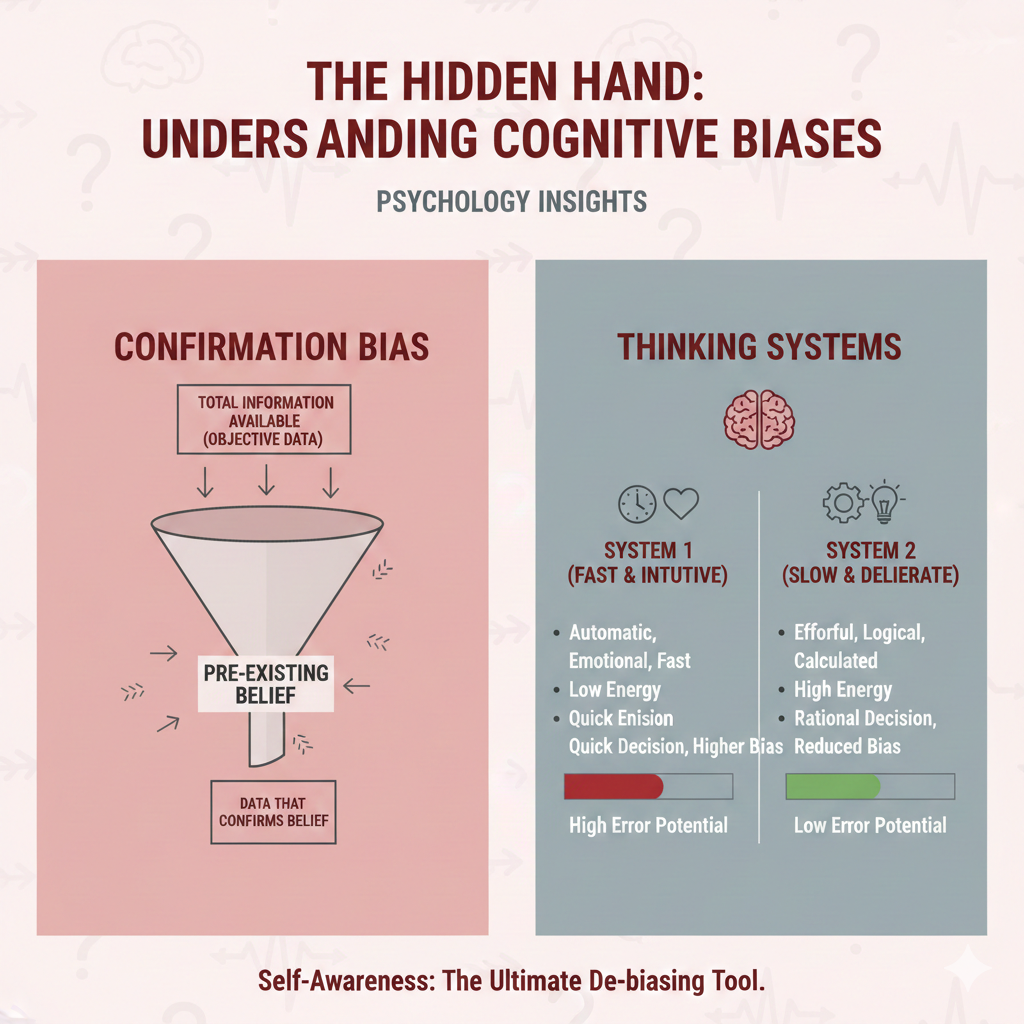
Infographic 1: The Confirmation Bias Funnel
Visualizing how we filter incoming information based on pre-existing beliefs. (Diagram shows Total Information Available being filtered through a Pre-existing Belief, resulting in only Data That Confirms Belief being processed.)
The Availability Heuristic
Another powerful bias is the Availability Heuristic, which causes us to overestimate the likelihood of events that are easily recalled, typically because they are vivid, dramatic, or recent. This is why people fear plane crashes more than car accidents, even though statistics overwhelmingly show the reverse to be true. The vivid, highly-publicized nature of a plane crash makes it instantly “available” in our memory, skewing our perception of risk.
Strategy for Awareness
While we can never fully eliminate cognitive biases, we can mitigate their impact. The key lies in metacognition—thinking about thinking. When faced with an important decision, try employing the following strategies:
- Seek Disconfirming Evidence: Actively look for information that contradicts your initial hypothesis.
- Devil’s Advocate: Mentally argue the opposite side of your own conclusion to test its flaws.
- De-bias by Delay: For important choices, implement a 24-hour waiting period to move from fast, emotional System 1 thinking to slower, rational System 2 thinking.
Infographic 2: Thinking Systems (Kahneman’s Model)
| Feature | System 1 (Fast & Intuitive) | System 2 (Slow & Deliberate) |
|---|---|---|
| Characteristics | Automatic, emotional, fast. | Effortful, logical, calculated. |
| Energy Cost | Low. | High. |
| Outcome | Quick decision, higher risk of bias. | Rational decision, reduced bias. |
| Error Potential | High | Low |
Ultimately, our cognitive biases are fundamental aspects of human nature, evolutionary tools designed for survival, not perfect logic. By shining a light on these “hidden hands,” we gain the power to pause, reflect, and make conscious choices that lead to better outcomes. Self-awareness is the ultimate de-biasing tool.